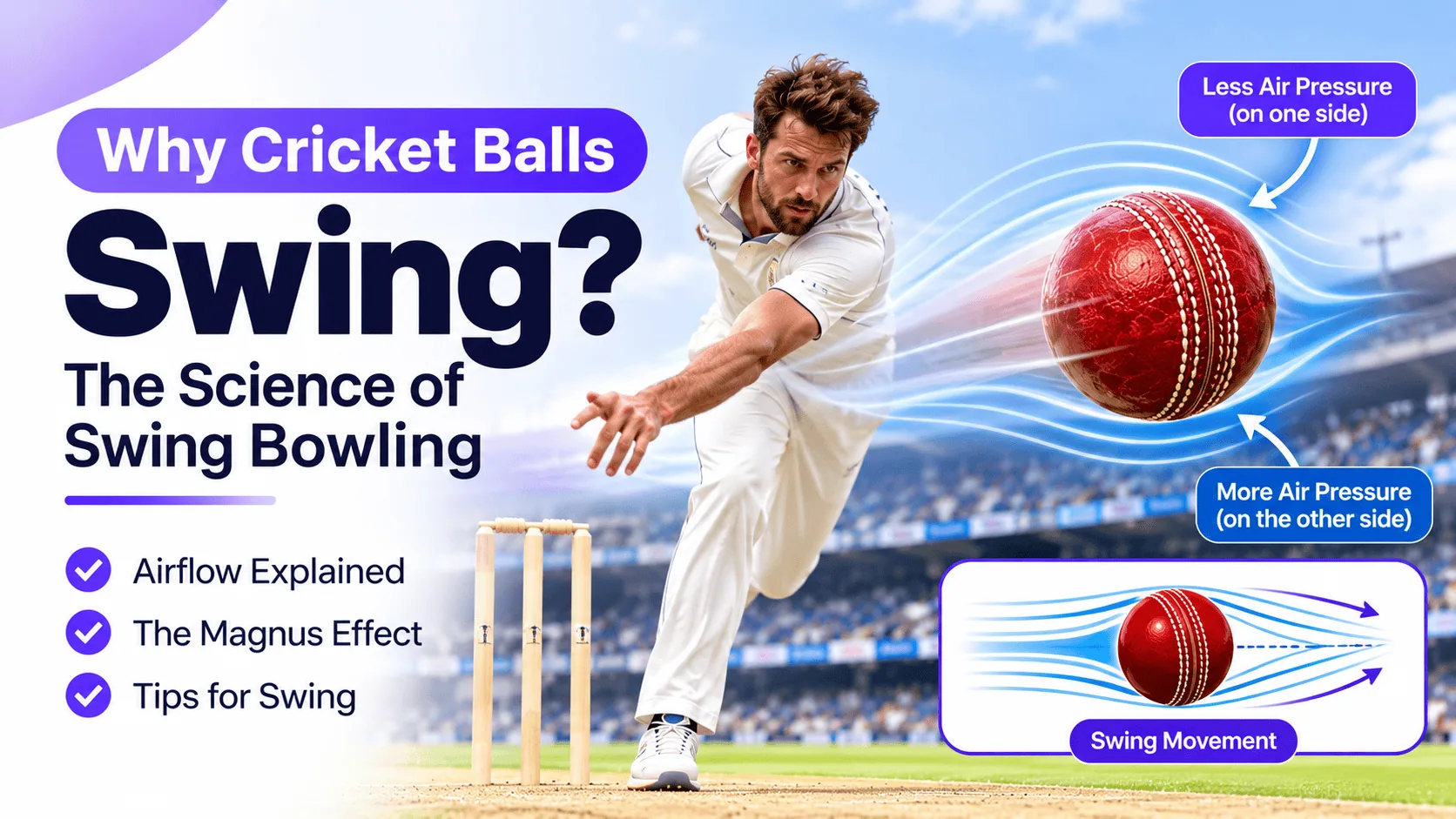
A cricket ball does not always travel in the direction a bowler intends. Sometimes, it appears to move sideways in mid-air, leaving the batter confused, the wicketkeeper alert, and the fielding team anticipating a wicket. This mysterious movement is known as swing bowling, one of the most fascinating skills in cricket.
But why does a cricket ball swing? Is it the bowler’s wrist position, the condition of the ball, the seam, the wind, or something happening in the air around it?
The answer lies in aerodynamics, airflow, air pressure, and the physical condition of the cricket ball. Swing bowling is not magic or simply a matter of luck. It is a scientific phenomenon that skilled fast bowlers learn to control through technique, precision, and experience.
From conventional swing to reverse swing, understanding why cricket balls move in the air reveals the science behind some of the most challenging deliveries in the game.
In this blog post, we will explore how swing bowling works, what makes a cricket ball swing, the difference between conventional and reverse swing, and how bowlers use these principles to outsmart batters.
What Is Swing Bowling in Cricket?
Swing bowling is a fast-bowling technique in which a cricket ball moves sideways through the air before reaching the batter. This lateral movement occurs because of differences in airflow and aerodynamic forces acting on the two sides of the ball.
Unlike seam movement, which happens when the ball hits the pitch, swing takes place while the ball is travelling through the air.
A bowler generally creates swing by controlling the seam position, wrist alignment, ball condition, and release angle. These factors influence how air flows around the ball and create a sideways aerodynamic force.
Swing bowling can make it difficult for batters to judge the ball’s final direction. A delivery that initially appears to be heading towards the stumps may move away at the last moment, or a ball outside off stump may swing back towards the batter.
This ability to change the ball’s trajectory makes swing bowling one of the most effective weapons in fast bowling.
Why Cricket Balls Swing? The Science Explained
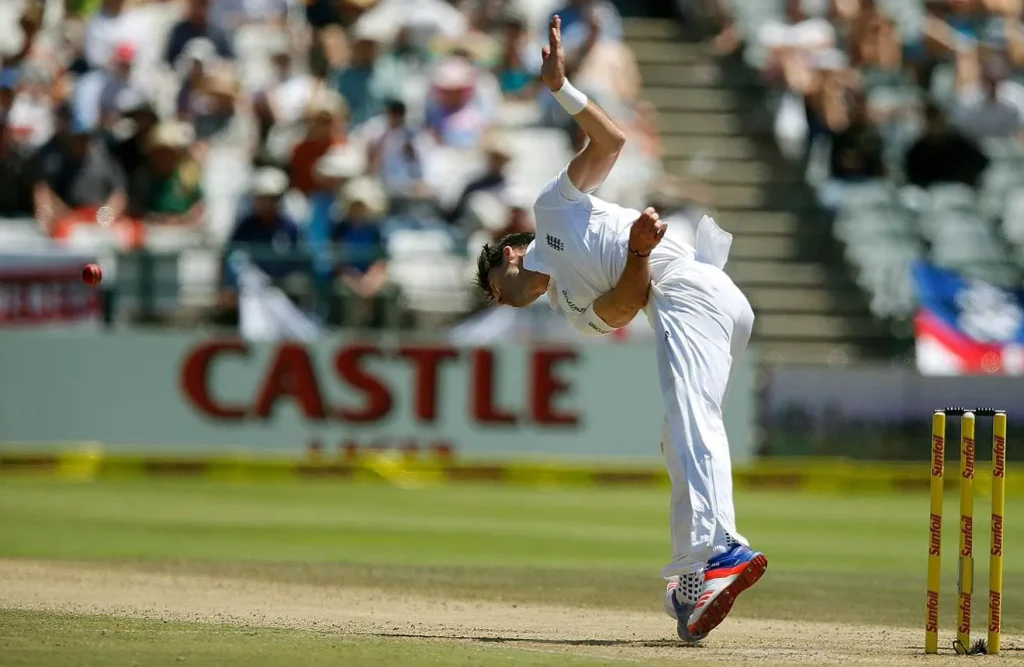
Cricket balls swing because airflow around the ball creates an aerodynamic force that pushes it sideways.
When a cricket ball moves through the air, the airflow around its two sides is influenced by its seam position, surface condition, speed, and direction of rotation. If the airflow behaves differently on each side, the resulting pressure and momentum differences can produce a sideways force.
This force changes the ball’s flight path, making it swing towards or away from the batter.
To understand the process, it is important to look at several scientific factors.
1. Airflow Around the Cricket Ball
As a cricket ball travels forward, air moves around its surface. The airflow does not always behave identically on both sides.
Depending on the seam orientation and surface condition, airflow can remain relatively smooth on one side and become turbulent on the other.
These differences affect the aerodynamic forces acting on the ball. The resulting sideways force can cause the ball to move laterally.
2. The Role of the Seam
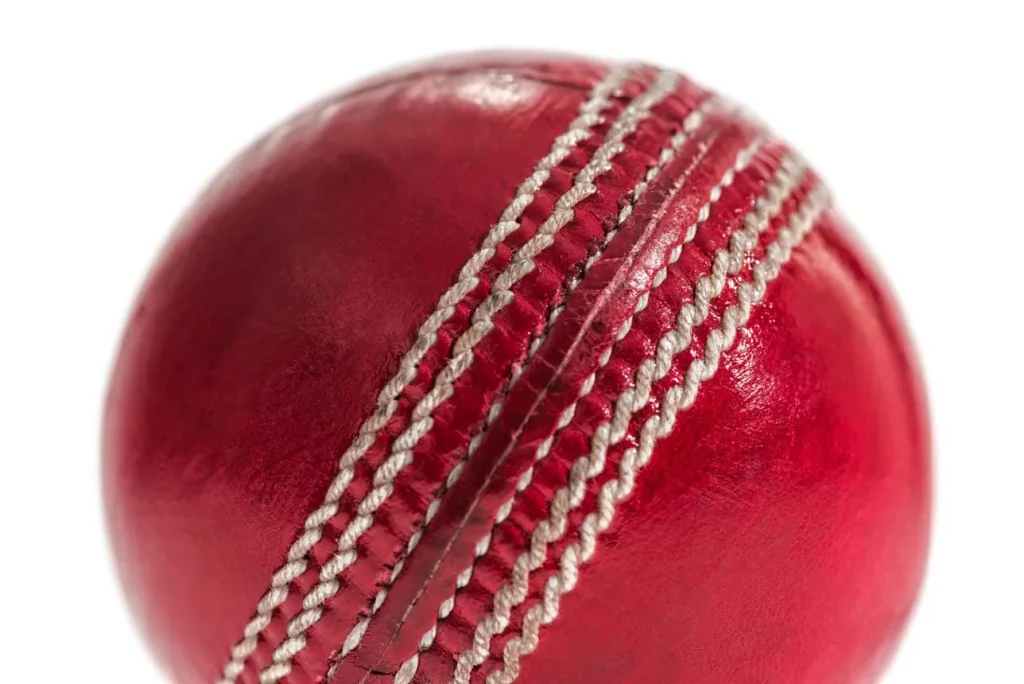
The raised seam is one of the most important features of a cricket ball when it comes to conventional swing.
A bowler tilts the seam at a particular angle rather than keeping it perfectly upright. This helps influence the airflow around the ball.
For conventional swing, the seam is generally angled towards the direction in which the bowler wants the ball to swing.
The seam acts as a small aerodynamic disturbance, influencing where the airflow transitions from smooth to turbulent. The resulting difference between the two sides contributes to lateral movement.
3. Difference in Air Pressure
Air pressure is another important part of swing bowling.
When the airflow around the two sides of a cricket ball behaves differently, the forces acting on those sides are no longer balanced.
This aerodynamic imbalance can create a sideways force.
However, swing is not explained simply by saying that air travels faster on one side and therefore produces lower pressure. The actual process involves boundary-layer behaviour, flow separation, turbulence, and the momentum of the air around the ball.
4. The Condition of the Cricket Ball
The condition of the ball can significantly influence its aerodynamic behaviour.
A relatively new cricket ball has a prominent seam and two leather halves that can be maintained differently during play. As one side becomes smoother and shinier while the other becomes rougher, the difference between the two surfaces can help skilled bowlers generate particular types of swing.
The ball’s age, surface roughness, moisture, and damage can all influence how it behaves in the air.
This is especially important when discussing reverse swing.
How Does Conventional Swing Work?
Conventional swing is the sideways movement of a cricket ball in the direction in which its seam is pointing. It is most commonly associated with a new or relatively new cricket ball.
For example, if a right-arm fast bowler angles the seam towards the slips, the ball can move away from a right-handed batter. This is called outswing.
If the seam is angled towards the leg side, the ball can move towards the batter. This is called inswing.
The basic mechanism involves the difference in airflow separation on the two sides of the ball.
When the seam is angled correctly, it influences the airflow along the seam side. Under suitable conditions, airflow separates at different positions on the seam and non-seam sides. This creates an asymmetrical wake behind the ball and produces a sideways aerodynamic force.
The ball consequently moves in the direction of the seam.
What Makes Conventional Swing Effective?
A few important factors help bowlers generate conventional swing.
A prominent seam: A clearly defined seam helps the bowler influence airflow around the ball.
A smooth non-seam side: Keeping one side relatively smooth helps maintain the airflow conditions required for conventional swing.
Correct seam position: The bowler must maintain a consistent seam angle throughout the delivery.
Stable wrist position: A firm wrist and controlled release help prevent the seam from wobbling excessively in flight.
Suitable bowling speed: The ball needs to travel within an appropriate aerodynamic range for the given ball condition and atmospheric environment.
Conventional swing is particularly effective when the ball is relatively new and its surface has not become excessively damaged.
What Is Reverse Swing in Cricket?
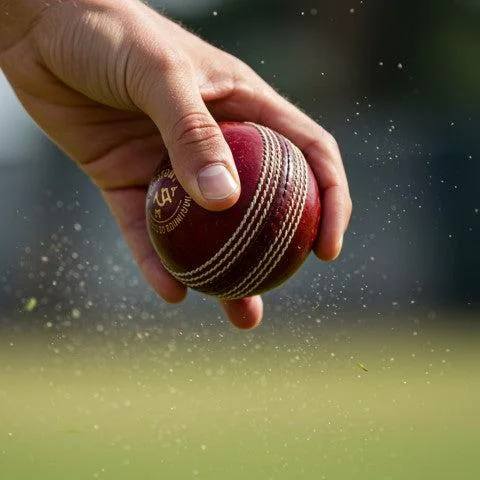
Reverse swing is a type of swing bowling in which the cricket ball moves in the opposite direction to the direction its seam is pointing.
It is generally associated with an older cricket ball travelling at high speed, although the exact conditions required depend on the ball’s surface, seam, speed, and surrounding airflow.
For example, a bowler may angle the seam towards the slips, but instead of moving towards the slips, the ball swings towards the batter.
This unexpected movement can make reverse swing extremely difficult to play.
How Does Reverse Swing Happen?
Reverse swing occurs when the aerodynamic behaviour of the ball changes.
As a cricket ball gets older, one side may become rougher while the other side remains relatively smooth because of the legal maintenance of the ball during the match.
At sufficiently high speeds, the airflow around the two sides can behave differently from the conventional swing situation.
The positions where airflow separates around the ball change, reversing the aerodynamic force responsible for swing.
As a result, the ball moves in the opposite direction to its seam.
However, reverse swing is not simply caused by having one rough side and one shiny side. The relationship between surface roughness, seam geometry, airflow, and bowling speed is more complicated.
Recent aerodynamic research has demonstrated that both sides of the ball influence the magnitude and direction of swing.
Conventional Swing vs Reverse Swing
Understanding the difference between conventional and reverse swing is essential for anyone learning the science of fast bowling.
| Feature | Conventional Swing | Reverse Swing |
|---|---|---|
| Ball condition | Usually new or relatively new | Usually older |
| Swing direction | Towards the seam | Opposite to the seam |
| Surface condition | Relatively smooth non-seam side | Often contrasting surface roughness |
| Bowling speed | Moderate to high | Generally high |
| Main mechanism | Asymmetrical airflow separation | Reversed asymmetrical airflow separation |
| Bowling challenge | Maintaining seam position | Controlling speed, seam and ball condition |
Both techniques depend on aerodynamic forces, but the airflow behaviour responsible for the movement is different.
What Factors Affect Cricket Ball Swing?
Swing bowling is influenced by several interconnected factors. A bowler may have excellent technique, but the ball will not necessarily swing if the aerodynamic conditions are unsuitable.
Let’s examine the most important factors.
1. Seam Position and Orientation
The seam is one of the most recognisable features of a cricket ball, and its position plays an important role in swing bowling.
A bowler generally releases the ball with the seam tilted at a specific angle relative to its direction of travel.
For conventional swing, the seam is usually directed towards the intended swing direction.
Maintaining this angle is important because excessive seam wobble can change the aerodynamic conditions around the ball.
2. Bowling Speed
Bowling speed has a significant influence on swing.
A faster ball changes the airflow conditions around its surface. At certain speeds, airflow can transition between different states, affecting the points where it separates from the ball.
This is why reverse swing is often associated with fast bowlers who can consistently generate high speeds.
However, there is no single universal speed at which reverse swing begins. The transition depends on the ball’s condition, seam characteristics, air properties, and other delivery conditions.
3. Condition of the Cricket Ball
The surface of a cricket ball changes as a match progresses.
Repeated contact with the pitch, bat, ground, and players gradually affects its condition.
A ball with a relatively smooth surface on one side and a naturally rougher surface on the other may produce different aerodynamic behaviour from a uniformly worn ball.
This difference can help bowlers generate conventional or reverse swing, depending on the conditions.
It is important to remember that ball maintenance must always follow the laws and playing conditions of cricket.
4. Wrist Position and Bowling Technique
The bowler’s wrist position is essential for controlling the seam.
A stable wrist helps the bowler release the ball with the intended seam orientation. If the wrist collapses or the seam wobbles excessively, it becomes harder to maintain consistent swing.
Professional swing bowlers spend considerable time practising their release technique to achieve repeatable seam positions.
5. Atmospheric Conditions
Weather and atmospheric conditions can influence swing, but their effects are often misunderstood.
Air temperature, atmospheric pressure, wind, and air density can change the aerodynamic conditions around a cricket ball.
Wind is particularly important because it changes the relative airflow experienced by the moving ball.
Humidity, however, is not a direct explanation for swing. Scientific research has found that its effect on the relevant aerodynamic conditions is very small compared with factors such as ball condition, speed, and seam orientation.
Does Weather Affect Cricket Ball Swing?
Yes, atmospheric conditions can influence how a cricket ball swings, but not in the simplistic way many cricket fans believe.
There is a common belief that cloudy weather automatically makes a cricket ball swing more. However, cloud cover itself does not directly create swing.
The actual movement depends on the aerodynamic conditions around the ball.
Cloudy Weather
Cloudy conditions are often associated with swing bowling because they can occur alongside changes in atmospheric conditions.
However, clouds do not physically pull the cricket ball in a particular direction. A ball can swing on a sunny day, and it may not swing much on an overcast day.
Humidity
Humidity is frequently mentioned as one of the biggest factors behind swing bowling.
However, the relationship is not as straightforward as popular cricket discussions suggest.
Research indicates that changes in humidity have a negligible direct effect on the Reynolds number governing the ball’s aerodynamic behaviour. Therefore, high humidity alone does not guarantee swing.
Wind Conditions
Wind can influence the relative speed and direction of airflow around a cricket ball.
A crosswind can also alter the direction of the aerodynamic forces experienced by the ball relative to the pitch.
This means wind conditions may influence both the amount and direction of observed movement.
Air Temperature and Pressure
Temperature and atmospheric pressure influence air density and viscosity.
These properties affect the Reynolds number, which is important in determining how airflow behaves around the cricket ball.
Consequently, atmospheric changes can influence the conditions under which conventional or reverse swing occurs.
What Is the Difference Between Swing and Seam Movement?
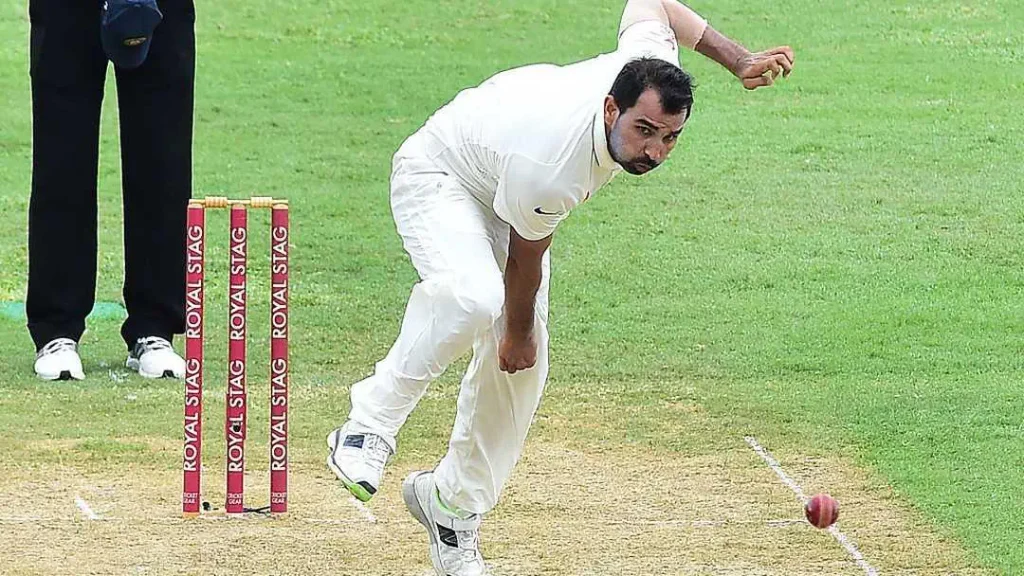
Swing and seam movement are two different types of lateral movement in cricket.
Although both can make life difficult for batters, they happen at different stages of the delivery.
Swing occurs in the air before the ball reaches the pitch. It is caused by aerodynamic forces acting on the moving cricket ball.
Seam movement occurs after the ball pitches. It happens when the seam makes contact with the playing surface and causes the ball to deviate from its expected path.
For example, a fast bowler may deliver an outswinger that moves away from the batter before pitching. After pitching, the ball may move further away because of seam movement.
A delivery can also swing in the air without producing any significant seam movement after bouncing.
| Feature | Swing Bowling | Seam Bowling |
|---|---|---|
| Movement occurs | Before pitching | After pitching |
| Main cause | Aerodynamic forces | Contact between seam and pitch |
| Key factor | Seam angle and airflow | Seam position and pitch condition |
| Commonly used by | Fast and medium-fast bowlers | Fast and medium-fast bowlers |
Understanding this difference helps explain why some deliveries move significantly in the air while others change direction after hitting the pitch.
What Is the Difference Between Swing and Spin in Cricket?
Swing and spin are both techniques used to deceive batters through changes in the ball’s trajectory. However, they work through different physical mechanisms.
Swing bowling primarily relies on aerodynamic forces created by airflow around the ball.
Spin bowling relies on the rotation imparted by the bowler. When a spinning ball interacts with the pitch, it can change direction after bouncing. A spinning ball can also drift in the air due to aerodynamic effects associated with its rotation, commonly explained through the Magnus effect.
Fast bowlers generally use swing to create movement before the ball reaches the batter, while spin bowlers use rotation to produce turn and variations in flight.
The key difference is that conventional swing is primarily associated with seam-related airflow asymmetry, whereas spin bowling depends on imparted rotation and its interaction with the surrounding air and playing surface.
Why Do Fast Bowlers Use Backspin When Swinging the Ball?
Backspin is another important aspect of swing bowling.
Many skilled fast bowlers impart a small amount of backspin when releasing the ball. This helps maintain rotational stability and can reduce unwanted changes in the seam’s orientation during flight.
A stable seam position allows the bowler to maintain the intended aerodynamic conditions for longer.
However, backspin does not automatically produce conventional swing. The seam orientation, surface condition, speed, and airflow remain essential factors.
The main objective is to deliver the ball with a controlled seam position so that it moves consistently through the air.
How Can Fast Bowlers Learn to Swing a Cricket Ball?
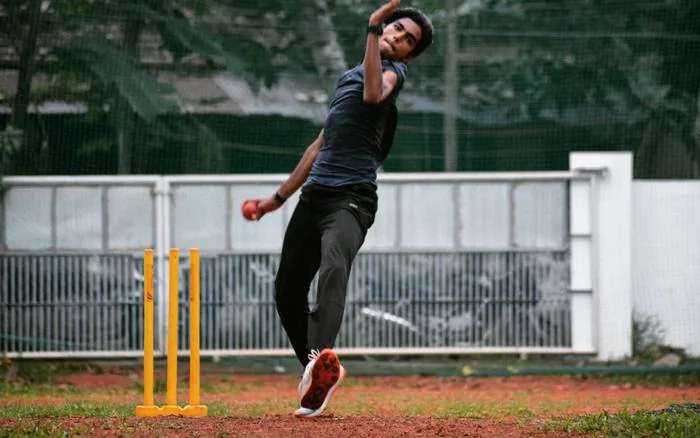
Swing bowling requires a combination of technical ability, practice, and an understanding of how a cricket ball behaves in the air.
A beginner does not need to bowl extremely fast to start learning swing. Developing a consistent bowling action and controlling the seam should come first.
Practise the Seam Position
Start by holding the cricket ball with your index and middle fingers on either side of the seam.
Keep the seam upright or at the intended angle for your delivery. Practise releasing the ball without allowing the seam to wobble excessively.
Develop a Consistent Wrist Position
Your wrist should remain firm and controlled during the delivery.
Avoid twisting your wrist unnecessarily while releasing the ball. A consistent wrist position makes it easier to control the seam and repeat your bowling action.
Learn Inswing and Outswing
Practise both directions of conventional swing.
For outswing, angle the seam towards the direction you want the ball to move. For inswing, reverse the seam angle.
Focus on controlling the seam rather than trying to generate maximum speed immediately.
Work on Your Bowling Speed
Once you can maintain a consistent seam position, gradually work on increasing your bowling speed.
Speed can influence the aerodynamic behaviour of the ball, but uncontrolled pace will not necessarily produce more swing.
Practise With Different Ball Conditions
As you gain experience, observe how a relatively new ball behaves compared with an older ball.
Notice how surface condition, seam position, and delivery speed influence movement.
Always follow the applicable cricket rules when maintaining the ball. Learning the natural effects of wear is part of understanding reverse swing.
Famous Cricket Bowlers Known for Swing Bowling
Cricket history features several legendary fast bowlers who made swing bowling an essential part of their success.
Wasim Akram
Widely regarded as one of the greatest swing bowlers in cricket history, Wasim Akram was particularly famous for his ability to generate conventional and reverse swing with exceptional control.
Waqar Younis
Waqar Younis became famous for his devastating reverse-swinging yorkers. His ability to combine high pace with late movement made him extremely dangerous.
James Anderson
James Anderson mastered conventional swing, particularly in English conditions. His ability to move the ball both ways made him one of the most successful Test fast bowlers.
Dale Steyn
Dale Steyn combined extreme pace, aggressive bowling, and the ability to generate movement in the air. His attacking approach made him a formidable fast bowler.
Bhuvneshwar Kumar
Bhuvneshwar Kumar is known for his exceptional ability to generate conventional swing at relatively modest bowling speeds, particularly with the new ball.
These bowlers demonstrate that swing bowling is not exclusively about speed. Control, technique, seam presentation, and an understanding of the ball’s behaviour are equally important.
Common Myths About Cricket Ball Swing
There are several misconceptions surrounding swing bowling. Understanding the actual science helps separate cricket traditions from aerodynamic facts.
Myth 1: A Cricket Ball Only Swings in Cloudy Weather
Fact: A cricket ball can swing in sunny, cloudy, or overcast conditions. Swing depends on airflow, ball condition, speed, and seam orientation rather than cloud cover alone.
Myth 2: High Humidity Always Produces More Swing
Fact: High humidity does not automatically increase swing. Scientific studies indicate that humidity has a very small direct effect on the aerodynamic parameters involved.
Myth 3: Only New Cricket Balls Can Swing
Fact: New balls are commonly associated with conventional swing, but older balls can also swing. In suitable conditions, they can produce reverse swing.
Myth 4: Faster Bowling Always Creates More Swing
Fact: Increasing speed does not guarantee increased swing. The relationship between speed and swing depends on several aerodynamic factors, and the ball may even change from conventional to reverse swing as conditions change.
Myth 5: Swing and Seam Movement Are the Same
Fact: Swing happens in the air, whereas seam movement happens after the ball contacts the pitch. They are two separate mechanisms.
Frequently Asked Questions About Cricket Ball Swing
These answers address some of the most common questions about swing bowling.
Why do cricket balls swing in the air?
Cricket balls swing because differences in airflow around their two sides create an aerodynamic force that pushes the ball sideways. Seam orientation, surface roughness, bowling speed, and airflow conditions influence this movement.
What makes a cricket ball swing towards the batter?
A cricket ball swings towards the batter when the aerodynamic force moves it in that direction. A bowler can achieve this through conventional inswing or, under suitable conditions, reverse swing.
Why does a new cricket ball swing more?
A relatively new cricket ball generally has a prominent seam and a better-preserved surface. These characteristics can help create the airflow differences required for conventional swing. However, the amount of swing also depends on speed, seam position, and atmospheric conditions.
Why does an old cricket ball produce reverse swing?
An older ball can develop contrasting surface conditions, with one side becoming rougher than the other. At suitable bowling speeds, these differences can reverse the aerodynamic force, causing the ball to move opposite to the direction of its seam.
Does humidity affect swing bowling?
Humidity has a very small direct effect on the aerodynamic properties responsible for cricket ball swing. High humidity does not guarantee that a ball will swing more.
At what speed does reverse swing occur?
There is no fixed bowling speed at which reverse swing always begins. It depends on the ball’s condition, seam characteristics, airflow, and atmospheric conditions. High-speed bowling generally makes reverse swing more achievable.
Can a cricket ball swing without a seam?
The raised seam is an important factor in conventional swing, but differences in surface roughness can also create aerodynamic asymmetry. This means a ball can experience movement through contrast in its surface condition, even when seam influence is reduced.
What is the difference between inswing and outswing?
Inswing is when the ball moves towards the batter, while outswing is when it moves away from the batter. Both are forms of conventional swing when the ball moves in the direction of its angled seam.
Which is more difficult to play: conventional swing or reverse swing?
Both can be challenging. Reverse swing is particularly difficult because the ball moves opposite to the direction suggested by its seam. However, the difficulty depends on the speed, amount of movement, timing, and batter’s technique.
Can spin bowlers make the ball swing?
Spin bowlers can generate lateral movement in the air through the Magnus effect, commonly called drift. However, this is different from conventional seam-driven swing bowling.
Conclusion: The Science That Makes Swing Bowling Special
Cricket ball swing is one of the best examples of science influencing sporting performance. What looks like an unpredictable movement is actually the result of aerodynamic forces acting on the ball as it travels through the air.
The seam, surface condition, bowling speed, wrist position, and atmospheric conditions all contribute to how much a cricket ball swings and in which direction.
Conventional swing occurs when the ball moves in the direction of its seam, while reverse swing happens when it moves in the opposite direction. Although both techniques rely on differences in airflow, their underlying aerodynamic behaviour is not identical.
For aspiring fast bowlers, understanding these principles can help develop better seam control, more consistent bowling techniques, and greater awareness of match conditions.
For cricket fans, it makes watching the game even more interesting. The next time a fast bowler beats a batter with a late-moving delivery, remember that there is a fascinating combination of skill, physics, and aerodynamics behind that moment.
That is what makes swing bowling so special: the bowler controls the release, but science helps determine the journey.
References
- A Review and Reassessment of the Aerodynamics of Cricket Ball Swing – Cambridge University Press (2024).
- Practical Perspective of Cricket Ball Swing – Sports Engineering (2019).
- Swing and Reverse Swing of a Cricket Ball – Journal of Fluid Mechanics (2024).
- Investigation of Reverse Swing and Magnus Effect on a Cricket Ball – Applied Sciences (2020).