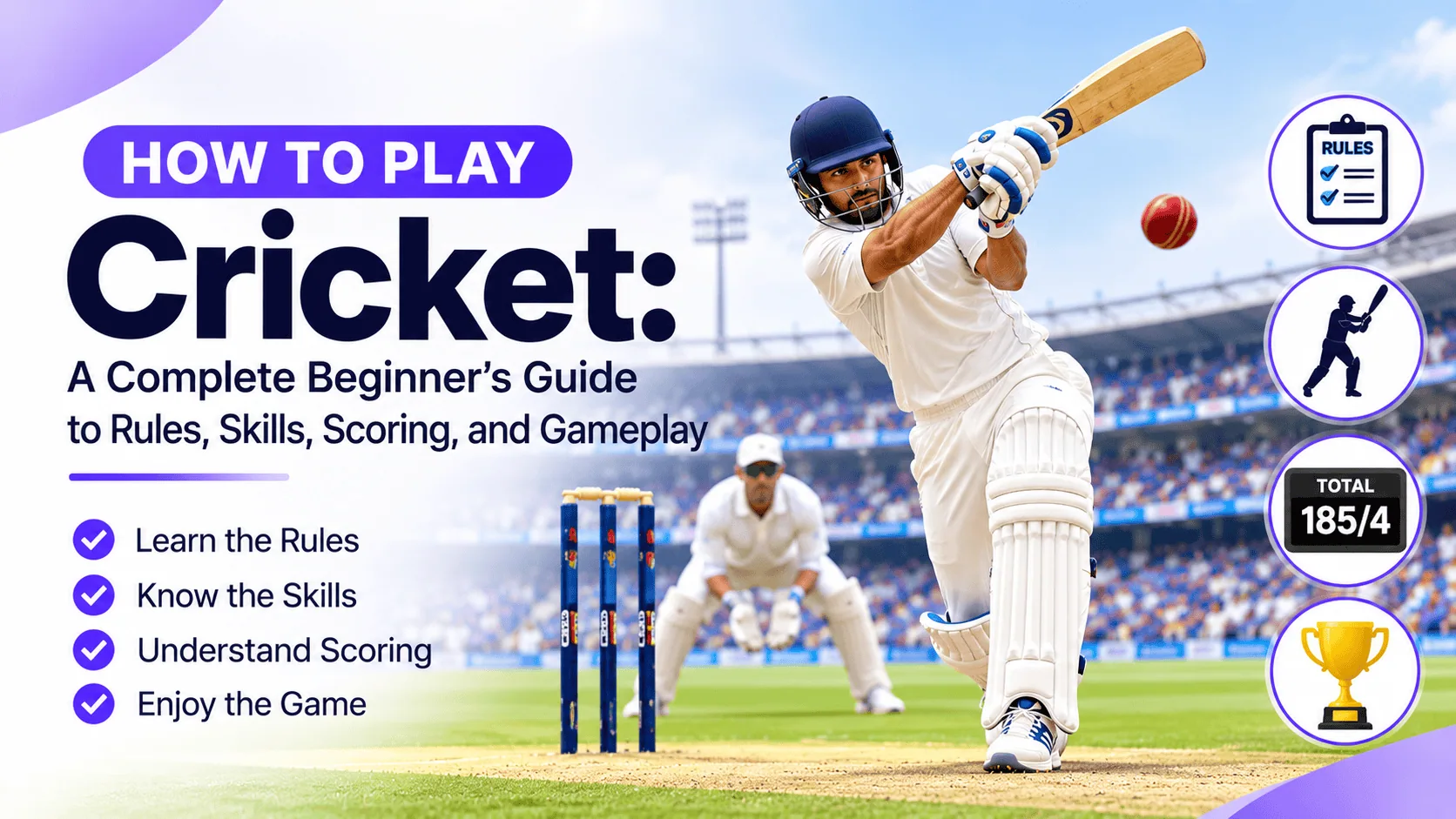
Cricket is one of the most exciting team sports in the world, bringing together strategy, skill, teamwork, and competition.
However, if you are new to the sport, understanding how to play cricket can initially seem challenging. What do the wickets mean? How do players score runs? What is an over? And how does a team win a cricket match?
The good news is that cricket is much easier to understand once you learn its basic rules and playing techniques. Whether you want to play cricket for fun, join a local cricket team, improve your skills, or simply understand what happens during an international match, learning the fundamentals is the perfect place to start.
In this comprehensive guide, you will learn how to play cricket step by step, understand the rules of the game, explore batting and bowling techniques, discover how scoring works, and become familiar with different cricket formats.
By the end, you will have the knowledge you need to start playing and enjoying cricket with confidence.
What Is Cricket?
Cricket is a bat-and-ball team sport played between two teams, usually consisting of 11 players each. The primary objective is to score more runs than the opposing team while trying to dismiss its batters and restrict their scoring opportunities.
The game takes place on a large field with a rectangular pitch in the middle. Each end of the pitch has a set of wooden stumps and bails, collectively known as a wicket.
During a match, one team bats to score runs while the other team bowls and fields to prevent runs and take wickets. Once the batting team’s innings ends, the teams switch responsibilities according to the match format.
The team that finishes with the better result wins the match.
Cricket is played in several formats, including Test cricket, One Day Internationals (ODIs), and Twenty20 (T20). Although the duration and playing conditions differ, the fundamental objective remains the same: score runs and take wickets.
How to Play Cricket: Understanding the Basic Rules
Before stepping onto a cricket field, you need to understand how the game works. Learning the basic rules will help you follow the action, understand players’ responsibilities, and participate in a match.
1. Understand the Teams and Players
A standard cricket match features two teams, with 11 players on each side.
One team starts by batting, while the other team takes the field. The batting team sends two batters onto the pitch, while the fielding team positions its players around the ground.
Each player has a specific responsibility. Some players specialize in batting, others focus on bowling, and some contribute to both activities.
The wicketkeeper is a particularly important fielding position. This player stands behind the batter’s wicket and attempts to catch the ball, prevent byes, and help dismiss batters through stumpings.
2. Learn About the Cricket Field and Pitch
Understanding the cricket field is essential because almost every action in the game happens around the pitch.
A standard cricket field has a large grass playing area, generally circular or oval in shape. The rectangular pitch is positioned in the middle.
The standard cricket pitch measures 22 yards (20.12 meters) in length and 10 feet (3.05 meters) in width.
At both ends of the pitch, you will find a wicket consisting of three vertical wooden stumps and two small horizontal bails.
The pitch also contains marked lines called creases. These markings help determine where batters and bowlers must position themselves during play.
The most important elements of a cricket field include:
Pitch: The central rectangular playing surface where batting and bowling take place.
Wickets: Three stumps and two bails positioned at each end of the pitch.
Bowling crease: The marked line that defines the bowler’s delivery position.
Batting crease: The line that helps determine whether a batter is safely inside their ground.
Boundary: The outer edge of the playing area. Hitting the ball to or beyond the boundary can earn the batting team four or six runs, depending on how the ball reaches it.
3. Decide Who Bats First
A cricket match usually begins with a coin toss between the two team captains.
The captain who wins the toss chooses whether their team will bat or field first.
This decision can depend on several factors, including pitch conditions, weather, ground conditions, and the team’s strengths.
If a team chooses to bat first, its objective is to build a strong total. The opposing team then attempts to restrict that score and chase the target when its turn to bat arrives.
4. Understand Batting and Fielding
Cricket involves two primary activities: batting and fielding.
The batting team focuses on scoring as many runs as possible while protecting its wickets. Two batters remain on the field together, one at each end of the pitch.
One batter faces the bowler and is called the striker. The other batter waits at the opposite end and is called the non-striker.
The fielding team attempts to prevent runs, catch the ball, and dismiss the batters. Its players spread across the field according to the captain’s strategy.
The bowler delivers the ball toward the striker, while the other fielders support the bowling effort.
5. Learn What an Over Means
An over is a set of six valid deliveries bowled by one bowler from one end of the pitch.
After completing an over, another bowler delivers the next over from the opposite end.
One important detail is that wides and no-balls do not count toward the six valid deliveries. Therefore, an over can involve more than six actual deliveries.
Understanding overs is particularly important in limited-overs cricket because each team has a fixed number of overs to score runs.
For example, a T20 match gives each team 20 overs, while an ODI gives each team 50 overs.
How to Bat in Cricket
Batting is one of the most important skills in cricket. The batter’s responsibility is to hit the ball, score runs, and avoid getting dismissed.
However, successful batting requires much more than simply swinging a cricket bat. Players need proper technique, timing, balance, concentration, and an understanding of different deliveries.
Here is how beginners can learn to bat in cricket.
1. Hold the Cricket Bat Correctly
Start by learning the correct grip.
Hold the handle with both hands close together. Your dominant hand should generally sit below your other hand, although the exact grip can vary depending on your batting style.
Keep your grip comfortable rather than excessively tight. This helps you control the bat and play different types of shots.
Your hands should work together to maintain balance and generate power when hitting the ball.
2. Maintain a Proper Batting Stance
Your batting stance determines how comfortably you can respond to an incoming delivery.
Stand sideways to the bowler with your feet approximately shoulder-width apart. Bend your knees slightly and keep your body relaxed.
Place the bat near your back foot while maintaining a balanced position.
Keep your eyes focused on the bowler and prepare to move in response to the delivery.
A comfortable stance helps you react quickly and play shots in different directions.
3. Watch the Ball Carefully
One of the most important batting fundamentals is watching the ball from the moment the bowler releases it.
Pay attention to its speed, direction, length, and movement.
This allows you to decide whether to defend the delivery, leave it, or attempt an attacking shot.
Beginners should focus on timing and control rather than trying to hit every delivery as hard as possible.
4. Learn Basic Cricket Batting Shots
There are several batting shots in cricket, each designed for different deliveries and playing situations.
Defensive Shot: A defensive shot helps protect the wicket against difficult deliveries. It is particularly useful when a batter wants to avoid taking unnecessary risks.
Straight Drive: The batter hits the ball straight down the ground, usually between the bowler and the sight screen.
Cover Drive: This elegant shot sends the ball through the cover region, typically on the off side.
Pull Shot: A batter uses this attacking shot against a short-pitched delivery, directing the ball toward the leg side.
Cut Shot: The cut shot is played against a short delivery outside off stump, usually sending the ball toward the point or backward point region.
Sweep Shot: This shot is commonly played against spin bowling, with the batter moving across the stumps and hitting the ball toward the leg side.
Learning these basic shots gives beginners a foundation for developing more advanced batting techniques.
5. Run Between the Wickets
Scoring runs is not limited to hitting boundaries. Batters can also score by running between the wickets.
When the batter hits the ball into an area where fielders cannot immediately retrieve it, both batters can run toward the opposite ends of the pitch.
One complete exchange of ends earns one run.
Batters can attempt additional runs if enough time is available before the fielding team returns the ball.
Good communication is essential. Both batters must clearly understand whether to run, stay, or return to their original positions.
How to Bowl in Cricket
Bowling is another fundamental skill that determines how a cricket match develops.
The bowler’s objective is to dismiss batters, restrict scoring opportunities, and create pressure through different types of deliveries.
Unlike batting, bowling requires a controlled delivery action, accuracy, consistency, and an understanding of the batter’s weaknesses.
1. Learn the Basic Bowling Grip
Start by holding the cricket ball comfortably with your fingers positioned along the seam.
For a conventional fast-bowling grip, the index and middle fingers generally rest on either side of the seam, with the thumb supporting the ball underneath.
Avoid gripping the ball too tightly because this can affect your control and release.
2. Practice Your Bowling Run-Up
A bowling run-up helps generate momentum before delivering the ball.
Start with a comfortable approach and gradually develop a consistent rhythm. Maintain balance throughout the run-up and prepare your body for the delivery stride.
Beginners should prioritize coordination and control rather than attempting to bowl at maximum speed.
3. Learn the Different Types of Bowling
Cricket has several bowling styles, but they generally fall into two major categories: fast bowling and spin bowling.
Fast Bowling
Fast bowlers rely on pace, bounce, movement, and variations to challenge batters.
Common fast-bowling deliveries include:
- Yorker: A delivery aimed at the batter’s feet or the base of the stumps.
- Bouncer: A short-pitched delivery that rises toward the batter’s upper body or head.
- Full-Length Delivery: A delivery that pitches relatively close to the batter.
- Slower Ball: A delivery designed to deceive the batter by reducing its speed.
- Swing Delivery: A delivery that moves through the air before reaching the batter.
Spin Bowling
Spin bowlers use finger or wrist movements to rotate the ball, making it change direction after pitching.
Common spin-bowling styles include:
- Off-spin: Generally turns from the off side toward the leg side for a right-handed batter.
- Leg-spin: Generally turns from the leg side toward the off side for a right-handed batter.
- Left-arm Orthodox Spin: A finger-spin delivery bowled with the left arm.
- Left-arm Wrist Spin: A wrist-spin delivery bowled with the left arm.
Each bowling style creates different challenges for batters.
4. Maintain Accuracy and Control
A good bowler does not need to deliver every ball at maximum speed.
Accuracy and consistency are equally important.
Try to bowl toward specific areas of the pitch and learn how different lengths and lines influence a batter’s response.
Practice regularly to improve your bowling rhythm, delivery action, and ability to control the ball.
Remember that cricket has specific laws governing the bowling action. Learn the correct legal delivery technique before attempting advanced bowling variations.
How to Field in Cricket
Fielding is the defensive side of cricket. It involves stopping the ball, preventing runs, catching batters out, and supporting the bowler.
A strong fielding team can completely change the direction of a match, even when its bowlers are not taking frequent wickets.
Important Fielding Skills for Beginners
Catching: Learn to catch the ball safely using both hands. Keep your eyes on the ball and position your hands according to its height and direction.
Ground Fielding: Practice stopping and collecting balls traveling along the ground. Maintain a balanced position and use your body effectively to prevent the ball from passing.
Throwing: Develop accurate and controlled throws toward the wicketkeeper or bowler. Accuracy is often more valuable than throwing with maximum force.
Wicketkeeping: The wicketkeeper stands behind the striker’s wicket and catches or collects deliveries that pass the batter. Wicketkeepers also attempt stumpings and support run-out opportunities.
Communication: Fielders must communicate clearly with one another to avoid collisions, organize catches, and prevent unnecessary runs.
Common Cricket Fielding Positions
Cricket uses several fielding positions, each serving a specific defensive or attacking purpose.
Slip: Positioned behind the batter on the off side to catch edges.
Gully: Located near the slip region, often to catch balls played off the edge.
Point: Positioned on the off side, generally square of the wicket.
Cover: Positioned on the off side between point and mid-off.
Mid-off: Located on the off side, closer to the bowler.
Mid-on: Located on the leg side, closer to the bowler.
Fine Leg: Positioned behind the batter on the leg side.
Square Leg: Located approximately square of the batter on the leg side.
Third Man: Positioned behind the wicket on the off side.
Long-on and Long-off: Positioned near the boundary on either side of the straight field.
Understanding these positions helps beginners recognize how fielding teams organize themselves during a match.
How to Score Runs in Cricket
Scoring runs is the central objective of batting. A team must accumulate more runs than its opponent to win a match.
There are several ways to score runs in cricket.
1. Running Between the Wickets
When a batter hits the ball into the field, both batters can run between the wickets.
Every successful exchange of ends earns one run.
Depending on the distance the ball travels and the fielders’ positions, batters can score one, two, or three runs, and occasionally more.
2. Scoring Four Runs
A batter scores four runs when the ball reaches or crosses the boundary after touching the ground within the playing area.
The batter does not need to run between the wickets when a boundary four is awarded.
3. Scoring Six Runs
A batter scores six runs when the ball is hit by the bat and crosses the boundary without first touching the ground inside the field.
A six is one of the most exciting scoring opportunities in cricket because it rewards a powerful aerial shot.
4. Understanding Extra Runs
Not all runs come directly from a batter hitting the ball.
Additional runs, known as extras, are awarded in certain situations.
Wide: A delivery that passes too far from the batter to be considered a fair opportunity to play a shot. It generally awards one extra run, subject to the applicable playing conditions.
No-Ball: An illegal delivery under the relevant bowling or delivery rules. It generally awards one extra run and can provide additional scoring opportunities.
Bye: Runs scored when the ball passes the batter without touching the bat or body, and the batters successfully run.
Leg Bye: Runs scored when the ball touches the batter’s body, without touching the bat, and the batters successfully run, provided the relevant conditions are satisfied.
Extras contribute to the team’s total score.
How Do Batters Get Out in Cricket?
Taking wickets is the primary objective of the bowling and fielding team.
A batter can be dismissed in several ways under the Laws of Cricket. Understanding the common methods will help you follow the game more easily.
Bowled
A batter is bowled when a legal delivery breaks the wicket and the relevant conditions for dismissal are satisfied.
Caught
A batter is caught when a fielder catches the ball before it touches the ground after the ball has touched the batter’s bat or hand holding the bat.
Leg Before Wicket (LBW)
The LBW occurs when the ball hits the batter’s body rather than the bat, and the conditions specified in the Laws of Cricket are satisfied.
The decision depends on factors such as where the ball pitches, where it strikes the batter, and whether it would have hit the stumps.
Run Out
A batter is run out when the wicket is fairly broken while the batter is outside their ground and not attempting to complete a run safely.
Stumped
A batter can be stumped when they leave their ground to play a delivery and the wicketkeeper fairly breaks the wicket while the batter is out of their ground, subject to the applicable conditions.
Hit Wicket
A batter is out hit wicket when they break their own wicket with their bat or body while playing the ball or setting off for a run, under the conditions of the relevant law.
Other Dismissal Methods
The Laws of Cricket also recognize less common dismissal methods, including hitting the ball twice, obstructing the field, and being timed out.
Learning these dismissal methods will help you understand how bowlers and fielders create opportunities to take wickets.
Understanding Cricket Innings and Match Formats
An innings is a team’s turn to bat.
The number of innings and the time or overs available depend on the format of cricket being played.
The three most popular international formats are Test cricket, One Day International cricket, and T20 cricket.
Test Cricket
Test cricket is the traditional and longest format of international cricket.
A Test match can last up to five days, with each team generally having two innings.
Unlike limited-overs cricket, teams are not restricted to a fixed number of overs for their innings.
Test cricket emphasizes patience, batting technique, bowling endurance, tactical decisions, and consistency.
A match can end in a win, loss, or draw, depending on the result and the available playing time.
One Day International (ODI) Cricket
One Day International cricket is a limited-overs format in which each team normally receives 50 overs to bat.
The team batting first attempts to build the highest possible total within its allotted overs.
The opposing team then tries to reach the target before losing all its available wickets or completing its innings.
ODI cricket combines strategic batting, controlled bowling, and aggressive scoring.
Twenty20 (T20) Cricket
T20 cricket is one of the shortest and most entertaining international formats.
Each team normally receives 20 overs to score runs.
Because batters have fewer deliveries available, the format encourages aggressive batting, innovative shots, and quick scoring.
T20 matches are generally completed within a few hours, making the format popular among modern cricket audiences.
What Equipment Do You Need to Play Cricket?
Having the right equipment is important for playing cricket comfortably and safely.
The equipment you need depends on the type of cricket you intend to play, the ball being used, and your playing environment.
Cricket Bat
A cricket bat is used to hit the ball and score runs. Choose a bat that is comfortable to hold and appropriate for your height, strength, and playing level.
Cricket Ball
The cricket ball is used by bowlers to challenge batters. Traditional hard-ball cricket generally uses a leather cricket ball, while casual games may use tennis balls or softer alternatives.
Stumps and Bails
Three stumps and two bails form the wicket at each end of the pitch.
Batting Pads
Batting pads protect the batter’s legs from fast deliveries.
Batting Gloves
Gloves protect the hands and fingers while improving grip and control over the bat.
Helmet
A cricket helmet protects the head and face from potentially dangerous deliveries. Properly fitted helmets are essential when facing hard-ball bowling.
Cricket Shoes
Cricket shoes provide grip, stability, and comfort while running, batting, bowling, and fielding.
Additional Protective Equipment
Depending on the level and conditions of play, players may also use abdominal guards, thigh guards, arm guards, and wicketkeeping gloves.
For beginners, safety should always come first. Use suitable protective equipment when playing with a hard cricket ball.
How to Start Playing Cricket as a Beginner
Understanding cricket rules is only the first step. To become a confident player, you need regular practice and opportunities to apply what you learn.
Here is a practical approach to getting started.
Start With the Basic Rules
First, understand the objective of cricket, how runs are scored, what an over means, and how wickets are taken.
You do not need to memorize every law before playing your first match. Focus on the fundamentals and learn more as you gain experience.
Practice Batting Regularly
Begin with simple batting drills.
Practice your stance, grip, defensive shots, and straight drives. Ask a partner to throw the ball toward you at a comfortable speed.
Gradually increase the difficulty as your timing and confidence improve.
Improve Your Bowling Technique
Start with basic bowling drills and focus on a consistent run-up, balanced delivery action, and accuracy.
Try to bowl toward a specific target rather than focusing entirely on speed.
Develop Your Fielding Skills
Practice catching, ground fielding, and throwing with teammates.
These activities help develop hand-eye coordination, reflexes, and confidence on the field.
Play Friendly Matches
One of the best ways to learn cricket is by playing with friends or joining a local cricket club.
Friendly matches help you understand how the rules work in real situations and give you experience in different playing positions.
Watch Professional Cricket
Watching professional cricket can help beginners understand batting strategies, bowling variations, field placements, and match situations.
Pay attention to how experienced players make decisions rather than focusing only on the final score.
Track Your Performance
Keep track of your batting runs, wickets, bowling figures, and fielding contributions.
Monitoring your performance helps you identify strengths, understand weaknesses, and set realistic improvement goals.
Essential Cricket Tips for Beginners
Becoming a better cricket player requires patience, consistency, and a willingness to learn.
Focus on Fundamentals: Develop a strong foundation in batting, bowling, and fielding before attempting advanced techniques.
Practice With Discipline: Regular practice helps improve coordination, accuracy, fitness, and confidence.
Understand Match Situations: Learn when to attack, defend, take singles, or protect your wickets.
Communicate With Teammates: Good communication helps prevent unnecessary run-outs and improves fielding coordination.
Maintain Physical Fitness: Cricket requires endurance, strength, flexibility, and quick reactions. Include suitable fitness exercises in your routine.
Respect the Rules and Opponents: Fair play, discipline, and sportsmanship are essential parts of cricket.
Common Mistakes Beginners Should Avoid
New players often make avoidable mistakes while learning cricket. Recognizing these problems early can help you develop better habits.
Trying to Hit Every Ball: Aggressive batting without considering the delivery often leads to unnecessary dismissals. Learn when to defend and when to attack.
Ignoring Batting Technique: An uncomfortable grip or unbalanced stance can affect your ability to play shots consistently.
Focusing Only on Bowling Speed: Accuracy, control, and variation are just as important as pace.
Poor Communication Between Batters: Running without clear communication can result in unnecessary run-outs.
Neglecting Fielding Practice: Fielding is a major part of cricket, and every player should develop basic catching, throwing, and ground-fielding skills.
Ignoring Safety Equipment: Playing hard-ball cricket without appropriate protection can increase the risk of injury.
Frequently Asked Questions About How to Play Cricket
How do you play cricket step by step?
To play cricket, divide players into two teams, usually with 11 players each. Conduct a coin toss to decide which team bats first. The batting team sends two batters onto the pitch, while the opposing team bowls and fields. Batters score runs by running between wickets and hitting boundaries. The fielding team attempts to dismiss the batters and restrict runs. Once the first innings ends, the teams switch roles. The team that achieves the better result wins.
How many players are there in a cricket team?
A standard cricket team has 11 players. During an innings, the batting team has two batters on the field, while the other team has 11 players performing bowling and fielding duties.
How many overs are there in cricket?
The number of overs depends on the cricket format. A T20 match normally gives each team 20 overs, while an ODI match gives each team 50 overs. Test cricket does not have a fixed number of overs per innings.
How many balls are there in one cricket over?
One standard over consists of six valid deliveries. Wides and no-balls do not count toward those six deliveries, so a bowler may need to deliver more than six balls to complete an over.
How do you score runs in cricket?
Batters score runs by running between the wickets, hitting boundaries for four runs, or hitting sixes when the ball crosses the boundary without bouncing inside the field. Additional runs can also come from extras such as wides, no-balls, byes, and leg byes.
What are the basic skills needed to play cricket?
The fundamental skills required to play cricket include batting, bowling, fielding, catching, throwing, running between wickets, and teamwork. Beginners should develop these skills through regular practice.
What is the easiest cricket format for beginners?
Short-format cricket, particularly casual T20-style or modified cricket, can be a good starting point for beginners. These games are shorter, easier to organize, and provide opportunities to practice batting, bowling, and fielding.
Can you play cricket with only a few players?
Yes. Cricket can be adapted for smaller groups. You can play casual cricket with two or more people using modified rules, reduced playing areas, and alternative equipment. However, official standard cricket is normally played with 11 players per team.
How long does a cricket match last?
Match duration depends on the format. T20 matches generally take a few hours, ODI matches usually take most of a day, and Test matches can last up to five days.
What is the difference between batting and bowling?
Batting is the activity of using a cricket bat to score runs and protect the wicket. Bowling involves delivering the ball toward the batter to restrict scoring and attempt to dismiss them.
What equipment does a beginner need to play cricket?
A beginner generally needs a cricket bat, ball, stumps, and suitable footwear. For hard-ball cricket, protective equipment such as a helmet, batting pads, gloves, and an abdominal guard is also important.
Final Thoughts
Cricket is a sport built around skill, strategy, teamwork, and the excitement of competition. Although its rules and terminology may seem complicated at first, understanding the fundamentals makes the game much easier to learn and enjoy.
From holding a cricket bat and learning different bowling techniques to scoring runs and taking wickets, every skill contributes to becoming a better player. The best way to improve is to practice consistently, understand the rules, learn from experienced players, and participate in friendly matches.
Whether you are playing cricket for fun, developing your skills, or preparing to join a competitive team, every great cricket journey starts with learning the basics.
And remember, cricket is not just about scoring the most runs or taking the most wickets. It is also about teamwork, sportsmanship, passion, and enjoying every moment of the game.
Take Your Cricket Experience to the Next Level with CricoScore!
Love cricket? Make every match more exciting with CricoScore, your all-in-one cricket scoring app. Score matches, track player performances, manage tournaments, and enjoy live cricket action—all in one place.
Whether you’re a player, scorer, team organizer, or cricket enthusiast, CricoScore brings everything you need closer to the game.
Leave a Reply